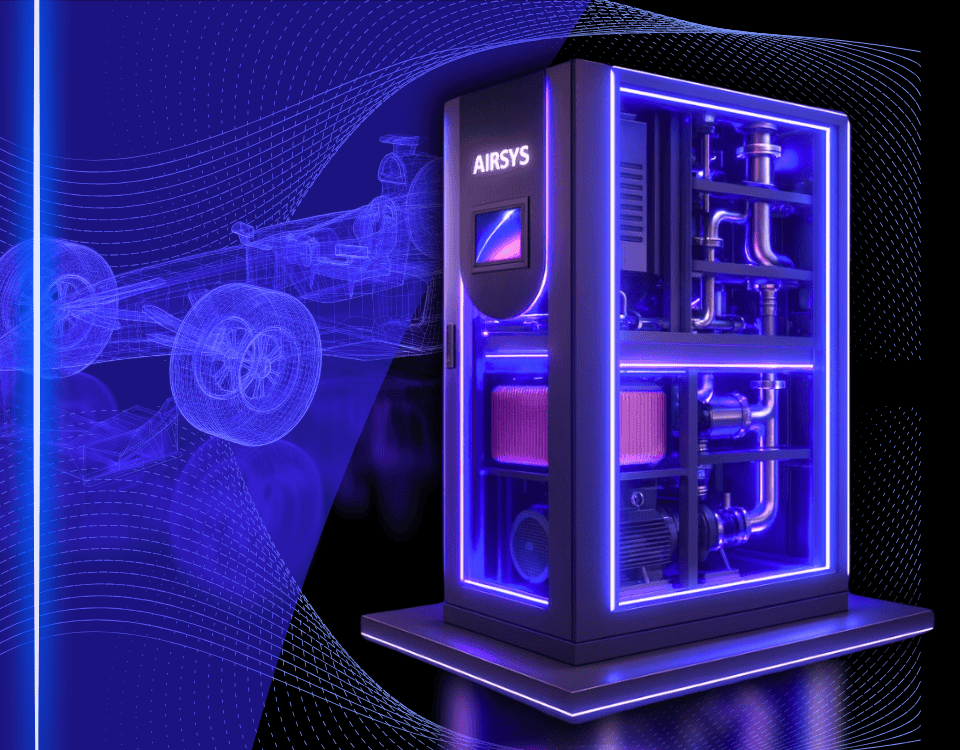

Airsys to Showcase Next-Gen AI Cooling Solutions and Regenerative Infrastructure Vision at Data Centre World London 2026
March 2, 2026
AIRSYS and TechAccess Partner to Accelerate Data Center Innovation Across Sub-Saharan Africa
March 11, 2026- Data centers are becoming more efficient, but their overall environmental footprint continues to grow.
- AI-driven infrastructure expansion is intensifying real-world impacts, including global warming pressure, water stress in vulnerable regions, and ecosystem disruption.
- Cooling is fundamental to building green data centers, as it represents one of the largest operational energy and water loads.
- Strategic cooling innovation enables data centers to balance high-performance outcomes with responsible resource use.
Sustainability has emerged as one of the defining data center trends in 2026. What was once viewed as a compliance issue is now shaping core infrastructure decisions and data center planning across both immediate operations and long-term development. The question is no longer whether sustainability matters, but how effectively it is integrated into core systems.
In this article, we examine the sustainability challenges facing modern data centers and explore cooling-focused strategies that can help address them through smarter infrastructure design.
How Sustainable Are Data Centers?
Data centers are essential to the digital economy, but their sustainability profile is complex and increasingly scrutinized. Despite steady gains in power efficiency and lower Power Usage Effectiveness (PUE) at the facility level, the overall environmental footprint continues to expand under the pressure of rapid growth and AI-driven demand. To put it differently, data centers are becoming more efficient, but not necessarily more sustainable at scale.
The Four Biggest Sustainability Challenges for Data Centers
Data center sustainability encompasses multiple environmental dimensions, from resource utilization to land use, and even noise pollution. This article zooms in on four of the most pressing and measurable sustainability challenges for data centers, which are also areas where targeted innovation can drive measurable improvement:
- Power consumption
- Greenhouse gas (GHG) emissions
- Water consumption
- Electronic waste (e-waste)
1. Energy Consumption
Data centers have long been known for being power-hungry. In 2024, global data centers consumed approximately 415 terawatt-hours (TWh) of electricity, which amounts to around 1.5% of total global electricity use. The consumption is projected to more than double to 945 TWh by 2030, a level slightly higher than Japan’s total electricity use today.
Even more concerning is the rate of growth. According to the International Energy Agency’s Energy and AI report:
- Data center electricity consumption has increased by roughly 12% annually since 2017.
- This growth rate is more than four times faster than the overall global electricity demand.
- In the United States, data centers are expected to account for nearly half of all electricity demand growth between now and 2030.
- By the end of the decade, U.S. electricity use for data centers could exceed consumption for aluminum, steel, cement, chemicals, and other energy-intensive industries combined.
2. GHG Emissions
The massive scale of data center power consumption creates a direct and unavoidable sustainability consequence: GHG emissions. The U.S. Environmental Protection Agency (EPA) reported in 2023 that data centers already accounted for around 1% of global GHG emissions, reflecting the fact that power generation remains the world’s largest source of CO2 emissions. In the United States alone, approximately 56% of the electricity used to power data centers comes from fossil fuels, meaning data center operations remain partially dependent on carbon-intensive power sources.
Other forward-looking analyses estimate that data centers’ share of global emissions may reach 2.5%-3.5%, with projections suggesting it could climb to as much as 8% by 2030 if growth outpaces efficiency gains and clean energy adoption.
3. Water Consumption
Electricity often dominates the sustainability conversation, but water use is another major and increasingly constrained resource. Many data centers rely on evaporative cooling systems that consume large volumes of water to reject heat. Yet, as facilities scale to support higher-density workloads, thermal demands intensify, placing even greater pressure on local water resources.
Data centers already rank among the top-10 industrial water consumers in the United States, with hyperscalers alone requiring with hyperscale facilities requiring tens to hundreds of millions of gallons of water annually, depending on size and cooling architecture.
The 2024 United States Data Center Energy Usage Report projected that annual onsite water use could increase by two to four times between 2023 and 2028, rising to roughly 150–280 billion liters.
4. Electronic Waste
E-waste is another often overlooked dimension of data center sustainability. Data centers house thousands of electrical hardware components, each with distinct life cycles and maintenance requirements. For example:
- Servers, batteries, and networking equipment typically need to be replaced every 3–5 years.
- In high-performance environments, upgrade cycles can be even shorter.
- In a Statista 2020 survey, 42% of IT managers reported replacing servers every 2–3 years.
These accelerated refresh cycles generate substantial volumes of e-waste, much of which is difficult to recycle. The rapid obsolescence of AI hardware, particularly GPUs and high-density servers, intensifies the problem, creating growing streams of hazardous materials that require specialized processing. Globally, 62 million tons of e-waste were generated in 2022, yet only 22.3% was formally collected and recycled.
The Negative Impacts of AI Data Centers on Sustainability
The statistics above quantify energy, water, and waste, but they do not fully capture the real-world consequences of AI-driven infrastructure expansion. As hyperscale facilities multiply and workloads intensify, sustainability challenges manifest in measurable effects on ecosystems, communities, and climate stability.
Climate Acceleration
Given their reliance on fossil-fuel-powered grids, increased data center energy consumption results in higher carbon emissions, intensifying global warming pressures. With the world approaching the 1.5°C warming threshold outlined in the Paris Agreement, any rapid increase in fossil-fuel-based electricity demand risks undermining global climate targets.
Water Stress in Vulnerable Regions
Water-intensive cooling systems are placing additional strain on regions already experiencing climate-related water shortages. For instance, municipalities in Arizona have tightened water allocation policies to high-consumption facilities, including data centers. In Georgia, residents have raised concerns about well water quality following the construction of a nearby Meta data center, raising concerns about local water availability and oversight.
Land Use and Ecosystem Disruption
The rapid expansion of hyperscale AI data centers is increasingly reshaping natural landscapes. Large-scale facilities often require rezoning agricultural land, clearing forests, or draining wetlands, leading to significant habitat disruption and biodiversity loss. Once these ecosystems are disturbed, the damage is often long-lasting or irreversible, weakening local climate resilience and environmental stability.
How Can Data Centers Become More Sustainable?
Given the trajectory of AI-driven growth and the sustainability pressures outlined above, it becomes clear that mitigating these environmental impacts is necessary. The good news is that, as was mentioned earlier, many of the pressures above can be addressed through strategic innovation.
Due to its significant share of a data center’s overall resource consumption, cooling is fundamental to building green data centers. Practically speaking, advancements in cooling design, efficiency, and water management offer some of the most meaningful pathways toward sustainable growth.
Cooling Strategies for Sustainable AI Data Centers
Improve Energy Efficiency to Lower PUE
Reducing overall energy intensity remains central to sustainable AI infrastructure. Cooling systems play a key role in improving PUE levels, as they account for a significant portion of non-IT energy consumption. Variable-speed components, high-efficiency heat exchangers, and compressor-free or reduced-compressor cooling architectures can significantly lower power demand.
Optimize Existing Power Usage
Power optimization in cooling systems can redirect freed-up capacity to IT equipment and compute generation. By reclaiming this “free” power, data centers can reduce their dependence on new power resources that are increasingly constrained and may not scale quickly enough to support AI growth. Achieving this requires operators to monitor a new performance metric: Power Compute Effectiveness (PCE), which measures how effectively a facility converts provisioned electrical capacity into productive compute load.
Adopt High-Efficiency Liquid Cooling
High-efficiency liquid cooling technologies, including spray-based and direct-to-chip systems, remove heat far more effectively than traditional air cooling. As such, these systems reduce fan energy, airflow requirements, and overall cooling power consumption.
Decrease New Water Dependency
While liquid cooling improves thermal efficiency, sustainability gains are maximized when systems minimize or eliminate daily water replenishment. Closed-loop architectures, advanced mechanical cooling, immersion solutions, and hybrid mechanical/direct-to-chip systems can significantly reduce dependence on evaporative cooling. The long-term objective is achieving 0 Water Usage Effectiveness (WUE), removing freshwater consumption from routine cooling operations, and reducing strain on water-sensitive regions.
Bring AI Into the Data Center
AI-driven cooling applies machine learning and predictive analytics to monitor, manage, and dynamically optimize thermal conditions in real time. Rather than operating reactively, intelligent systems continuously analyze performance data to adjust cooling output based on workload demand. Through real-time analysis, dynamic optimization, and predictive maintenance capabilities, AI-enabled cooling reduces energy waste while improving operational resilience.
Design Cooling Systems for Simplified Maintenance
Preventive maintenance plays a critical role in extending hardware lifespan and, therefore, reducing e-waste. Cooling systems designed for accessibility, such as with modular components, pull-out servers, and full access to internal hardware, make routine servicing faster and more effective. When maintenance is simplified, components are repaired rather than prematurely replaced, reducing unnecessary hardware turnover.
Decarbonize Cooling with Green Energy
Powering cooling systems with renewable energy sources, such as solar, wind, or geothermal, reduces the carbon intensity of data center operations. Also, the transition to green refrigerants, including A2L-class alternatives, supports regulatory compliance and reduces environmental impact.
Recover Heat and Water Recycling
Cooling infrastructure removes heat, but it can also repurpose it. Waste heat captured from cooling loops can be redistributed to nearby buildings or district heating networks, transforming excess thermal energy into a usable community resource. At the same time, cooling-integrated water recycling can reduce freshwater withdrawal and limit discharge.
How Cooling Innovation Addresses Data Center Sustainability Challenges
| Sustainability Challenge | Cooling-Focused Strategy |
| High Cooling Energy Consumption |
|
| GHG Emissions |
|
| Water Stress |
|
| E-Waste |
|
Balancing Cooling Performance with Environmental Responsibility
As it turns out, the future of sustainable AI infrastructure will be shaped by how intelligently data centers manage heat, power, and water, and cooling sits at the center of this equation. Through a thoughtful approach to cooling, data centers can and should become more sustainable, not only to support the digital, data-driven world we rely on, but to ensure that growth does not come at the expense of environmental health.
At Airsys, our commitment to sustainability is reflected in our mission to “balance the environment,” a principle embedded in how we design, engineer, and operate. Every cooling system we develop is built to strike the right balance between high-impact cooling performance and optimized resource use. The result is a responsible approach that transforms cooling from a resource consumer into a driver of sustainability.
Contact us to learn how intelligent cooling design can support your sustainability goals.