Liquid Cooling, Finally Built for the Edge
April 28, 2026
Airsys Expands Executive Leadership Team to Meet Surging Global Demand for AI and Data Center Cooling
May 6, 2026Instead of forcing customers to choose between products which don’t fully meet their needs, the answer may be a “third category” technology like the iPad or server-level liquid cooling.
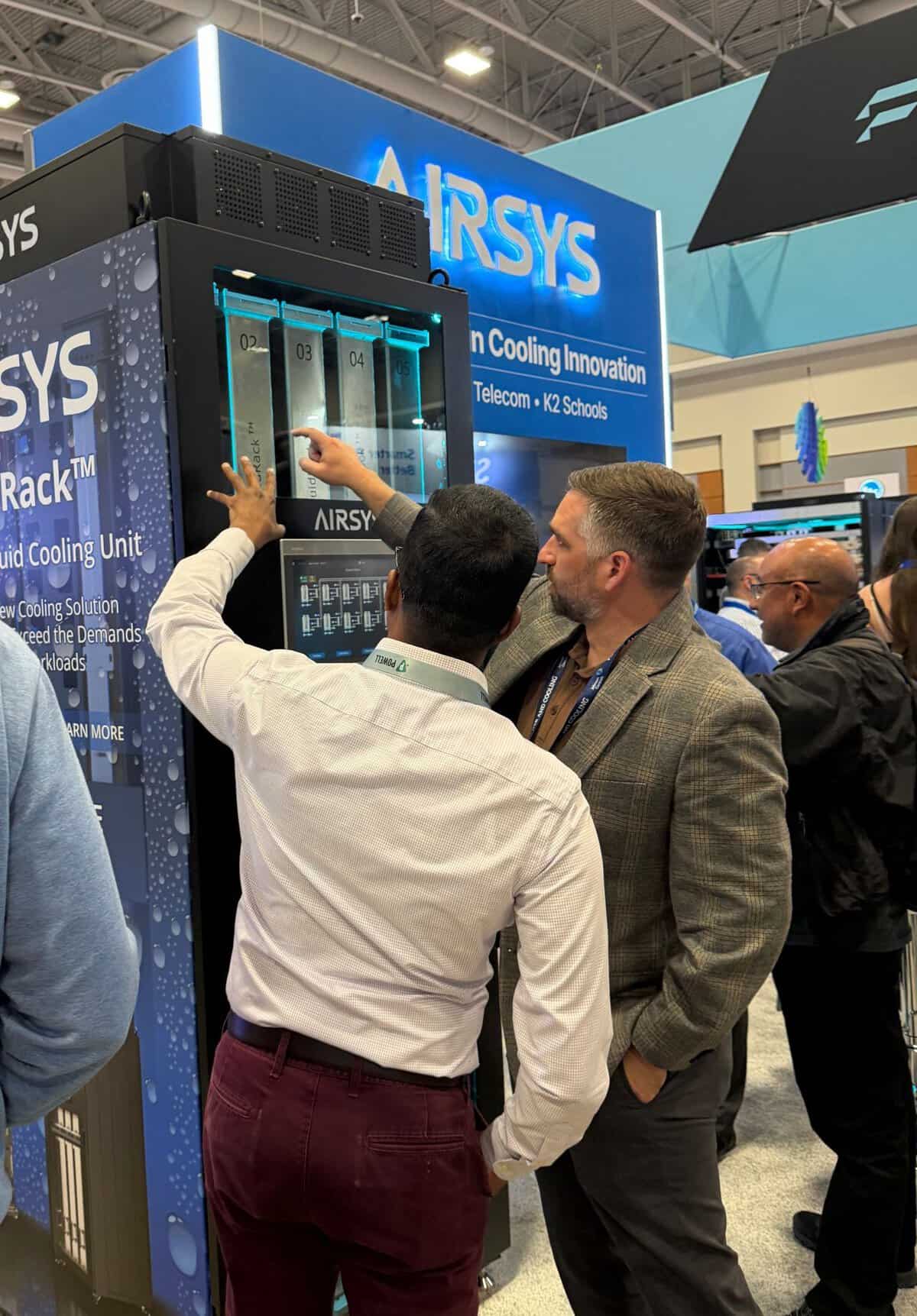
The recent Data Center World (DCW) event in Washington, D.C., brought together many of the industry’s leading thinkers and innovators. But while the sector was showcasing its latest breakthroughs, another announcement was capturing the wider tech world’s attention: Apple revealed that Tim Cook will step down as CEO later this year, with senior vice president of hardware engineering John Ternus set to take the helm.
At first glance, these two events seem unrelated. But Apple’s history offers a useful analogy for understanding a technology shift in the data center. Under Steve Jobs and later Tim Cook, Apple repeatedly redefined existing product categories — most famously with the iPhone — while also creating entirely new ones. The iPad, which Ternus played a key role in bringing to market, is the classic example of a “third category”: a device for users who found neither a phone nor a laptop quite right.
As Steve Jobs described it at the launch of the iPad in 2010: “If there’s going to be a third category of device, it’s going to have to be better at these kinds of tasks than a laptop or a smartphone, otherwise it has no reason for being.”
Apple didn’t invent the tablet, but it transformed the category. More than 670 million iPads have reportedly been sold to date. The innovation on display at DCW shows that the data‑center industry is undergoing its own version of this shift. Liquid cooling, once a niche technology, has become mission‑critical as AI drives unprecedented thermal densities. In many ways, the overall shift from traditional air cooling to liquid mirrors the trajectory of Apple’s most innovative product — the iPhone: a disruptive technology that eventually reshaped an entire market.
But just as the iPad was effectively born from the iPhone’s success, the relationship between different forms of liquid cooling is equally nuanced. Operators still deploy both air and liquid cooling, and within liquid cooling they’ve historically had to choose between two main options: direct‑to‑chip (DTC) and full immersion. DTC, which pumps coolant through cold plates mounted on processors, has gained market share thanks to its flexibility. However, there are challenges in terms of the proportion of heat captured and overall density supported. Immersion cooling, where servers are submerged in dielectric fluid, offers strong thermal performance but introduces challenges around weight, infrastructure changes, and server modification.
Entering the Third Category: Server-Level Precision Spray Cooling
Server-level liquid cooling (SLCU) offers an iPad‑like third category – combining the flexibility of DTC with the thermal efficiency of immersion. Airsys officially launched the next generation of its SLCU technology LiquidRack™ at DCW 2026. This architectural shift directly addresses how Airsys LiquidRack™ optimizes cooling for high-density AI deployments.
Just as the iPad bridged the gap between laptops and the iPhone, LiquidRack™ is designed for operators transitioning from air cooling who need to manage rising thermal loads without adding unnecessary complexity. By integrating key cooling functions directly into the rack, LiquidRack™ enables a more incremental and manageable shift to liquid cooling, making liquid cooling practical for high-density edge centers, localized enterprise clusters, and remote telecom hubs alike.
LiquidRack™ removes the need for massive external Cooling Distribution Units (CDUs) or compressors, and the 3D-printed precision spray‑cooling technology uses up to 80% less dielectric fluid than immersion systems. Its cassette‑based architecture reduces cooling infrastructure while supporting both retrofits and new builds. Crucially, by localizing thermal management at the rack, LiquidRack™ helps operators reclaim stranded power capacity, improving Power Compute Effectiveness (PCE), which measures the portion of provisioned data center power allocated to compute.
We’ll learn more after Sept. 1, 2026, about the new third‑category products Apple may introduce under Ternus’s leadership — perhaps even a foldable iPhone that bridges the gap between today’s iPhone and iPad. What’s already clear is that AI and escalating compute demand will continue to reshape data‑center infrastructure, especially cooling. Other liquid cooling form factors and technologies continue to emerge and disrupt the market including two-phase cold plate technology from suppliers such as Aegis (an Airsys company).
It will fall to innovative suppliers to anticipate customer needs, sometimes before customers can articulate them. As Steve Jobs famously said, “People don’t know what they want until you show it to them.”