
Airsys Appoints Marcio Kenji as Vice President for Latin America to Drive Regional Growth and Strategy
April 24, 2026
Why Server-Level Liquid Cooling is the iPad Moment for Thermal Innovation
April 28, 2026
How LiquidRack™ delivers high-density performance in the places that need it most
The promise of edge computing is simple: deliver high-performance processing closer to where data is generated—but turning that vision into reality is not always easy. Telecommunications facilities, enterprise branch sites, factory floors, and distributed colocation racks were designed long before AI inference and GPU-driven workloads existed. They are now expected to run them anyway — continuously, reliably, and at densities that the original infrastructure was never built to support.
This is the edge thermal problem. It is not a future concern. It is what operators are navigating today, as every new workload pushes rack power higher and the available cooling headroom stays the same.
The Infrastructure Gap That Is Holding the Edge Back
Most edge sites were sized for a fundamentally different era. Communications closets built for routing and switching. Industrial enclosures designed for control systems. Enterprise satellite offices with nothing more than building HVAC to manage IT heat. Now those same spaces are being asked to run analytics engines, AI models, and always-on compute at densities that produce 40, 60, or even 80 kilowatts of heat per rack.
The result is a familiar and frustrating constraint: operators are forced to choose between the compute density their workloads demand and the thermal budget their infrastructure can support. Without a cooling architecture designed for the edge, the edge cannot deliver what it promises.
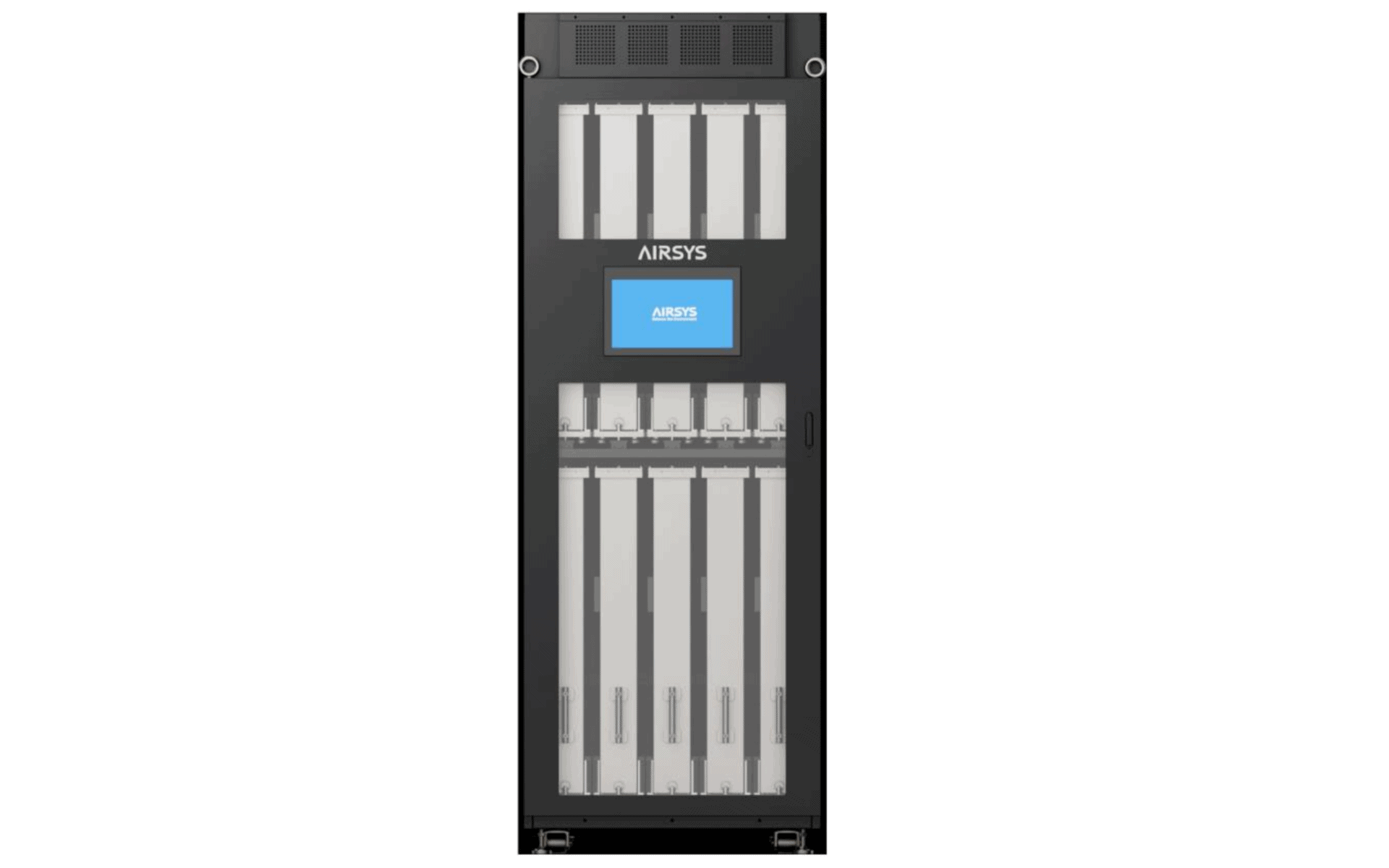
LiquidRack™ — rack-level liquid cooling with no CDU required
The LiquidRack™ Advantage at the Edge
LiquidRack™ from AIRSYS was engineered to resolve this tension. It is a rack-level liquid cooling system built around precision spray-based heat transfer — a fundamentally different approach that makes genuine high-density cooling viable in the locations where it has never been practical before.
Here is what that means in practice:
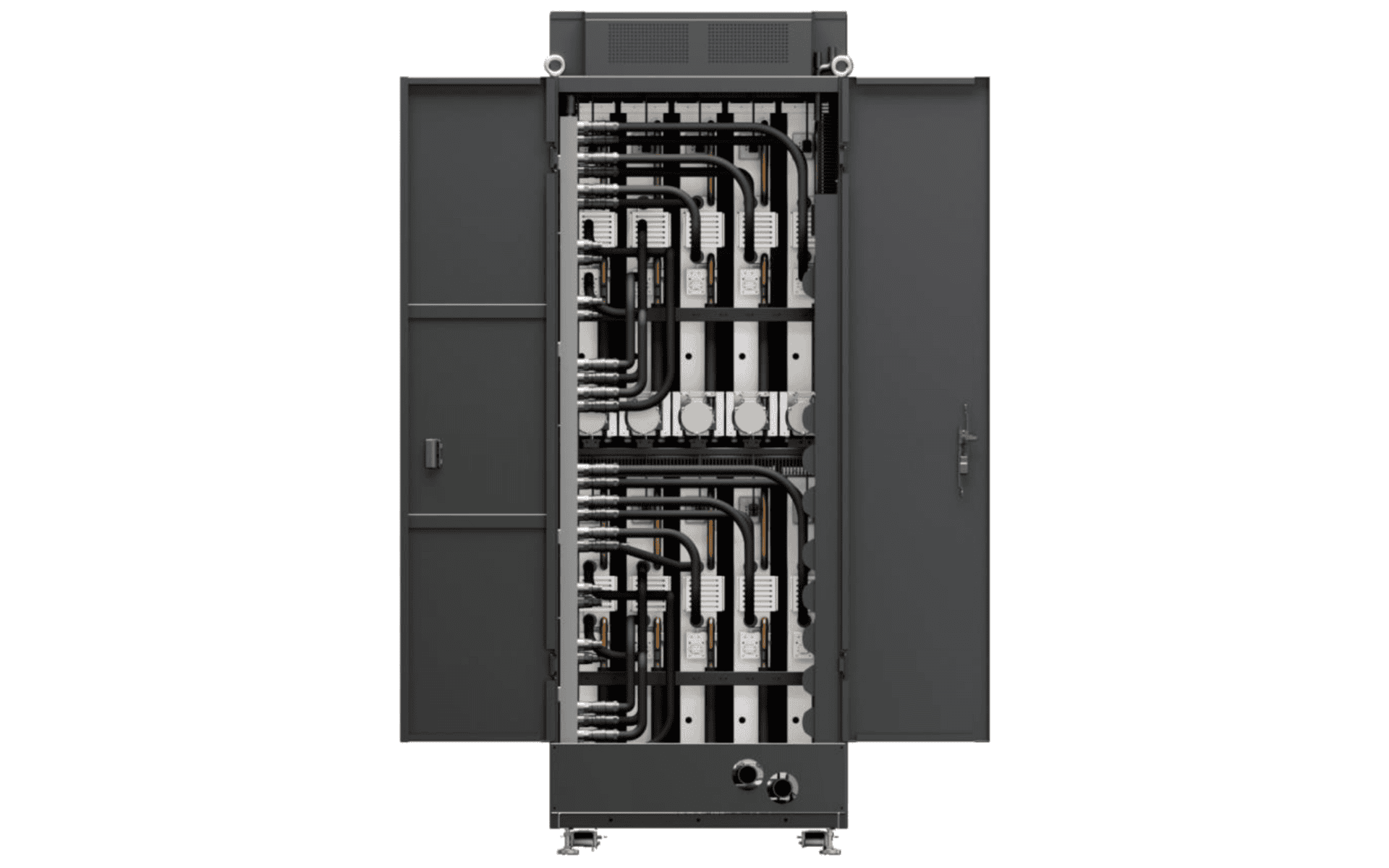
LiquidRack™ internal architecture — rack-level fluid distribution with independent per-cassette pumps
- No chiller. No CDU. No specialized plant: LiquidRack™ can deliver up to 80 kW of cooling per rack using only a dry cooler, even at 45°C ambient temperatures. If 50°C ambient temperature is preferred, LiquidRack™ can deliver 63kW of cooling. There is no requirement for a centralized Coolant Distribution Unit, no chilled water loop, and no mechanical refrigeration. For an edge site with one rack or five, this eliminates the infrastructure overhead that has made liquid cooling impractical outside of large data centers, saving cost on power while increasing compute potential.
- A fraction of the fluid volume: Rather than submerging hardware in bulk dielectric fluid, LiquidRack™ uses 3D-printed precision spray nozzles to deliver targeted coolant directly to CPU and GPU surfaces. This approach reduces dielectric fluid requirements by up to 80% compared to full-immersion systems, dramatically lowering cost, weight, and logistical complexity.
- Density that changes what the edge can do: with up to 80 kW cooling capacity with a dry cooler alone, LiquidRack™ unlocks compute density that was previously impossible at the edge. AI inference workloads, GPU clusters, and HPC applications can now be deployed in facilities that could only support air-cooled servers before.
- Free cooling, year-round: Because LiquidRack™ operates at elevated liquid temperatures without compromising CPU junction temperature, mechanical chilling is not required across a broad range of climates and seasons. Year-round free cooling is achievable, eliminating one of the largest ongoing cost drivers in edge thermal management.
Up to 80 kW per rack. Dry cooler only. No CDU. No chiller. This is what liquid cooling at the edge looks like when it is actually designed for the edge.
Designed for the Operational Reality of the Edge
Thermal performance is necessary but insufficient. Edge deployments succeed or fail on operational practicality. LiquidRack™ was engineered with this constraint at its center.
- Independent cassette servicing: Each 2U server cassette can be accessed, serviced, and replaced independently using an auto-lift mechanism — without shutting down adjacent cassettes or draining the system. Routine maintenance is a simple tasktask, not a facility-wide operation.
- Hot-swappable modules: The standardized modular design supports hardware changes across various server configurations without requiring system downtime, critical for edge environments with limited maintenance windows.
- Full DC compatibility: LiquidRack™ integrates with existing data center infrastructure without retrofitting server hardware. Standard rack, power, and network configurations are preserved, protecting existing investments.
- Per-cassette real-time monitoring: Temperature, coolant pressure, pump status, flow rate, and fluid level are monitored individually for each cassette via Modbus and BACnet protocols, with touchscreen local control and remote alarm capability. Edge sites with minimal on-site staff can be managed from a central NOC with full thermal visibility.
- Proactive vapor management: Dielectric oil is sealed within each cassette maintaining air quality in enclosed edge environments and preventing fluid migration outside the rack.
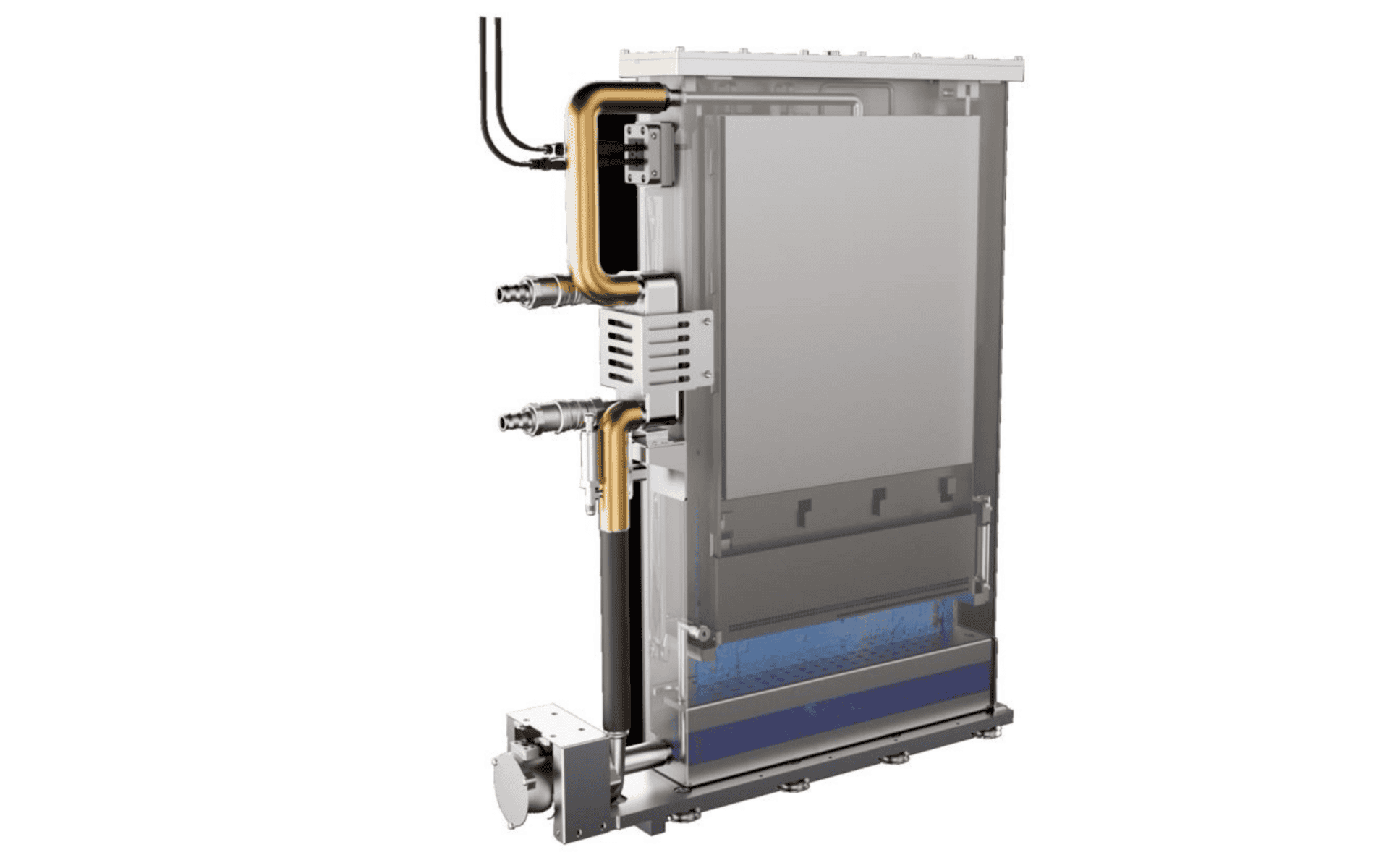
2U server cassette with integrated pump and plate heat exchanger — independently serviceable without system downtime
Built for the Places That Power Has Overlooked
The edge is not a single environment. It is a telecommunications hub with a handful of racks in a concrete equipment room. It is an enterprise campus facility that runs business-critical analytics but has no raised floor. It is a distributed colocation site where a retrofit project needs to unlock AI compute without a complete facility rebuild.
LiquidRack™ was designed for exactly these contexts. The rack-level architecture requires no external fluid handling plant. The server-based spray cooling cassettes have fully sealed, individual loops, maintaining air quality in enclosed environments. The modular cassette design scales from a single rack to a full deployment, with each unit operating independently.
For operators facing the convergence of rising compute density, constrained power availability, and aging infrastructure, LiquidRack™ does not require a greenfield facility or a large-scale retrofit. It requires just a water connection, a heat rejection path, and a rack.
Ready to bring high-density cooling to your edge sites?
LiquidRack™ is available now for retrofit and new-build edge deployments. To learn more about how it can work in your environment, visit airsysnorthamerica.com or contact the AIRSYS team directly.