
Why Power-Efficient Data Centers Can Still Miss Revenue Targets?
February 17, 2026
The Real Power of Data Centers Isn’t Megawatts. It’s Stewardship.
February 25, 2026Most conversations about data centers focus on power. Far less attention is paid to the other resource quietly keeping digital infrastructure running: water. Behind every workload is a cooling system that depends, directly and indirectly, on water to manage heat and maintain reliability.
The challenge is that water, like power, is a finite resource, and as AI-driven workloads intensify, cooling requirements are set to rise, driving water consumption higher. That makes it increasingly important to understand how much water data centers consume, and what we can do about it.
Why Do Data Centers Require So Much Water?
Data centers require significant amounts of water to support the two systems that effectively keep them alive:
- Direct water use for cooling accounts for about 25% of the facility’s footprint.
- Indirect water use across energy and manufacturing supply chains accounts for the remaining 75%.
Direct Water Use: Cooling Operations
Data centers commonly use water to cool IT hardware and manage heat. Some cooling strategies rely on evaporative techniques to reject heat, in which a portion of the water vaporizes. As a result, fresh water must be continuously added to make up for the water lost to evaporation during cooling.
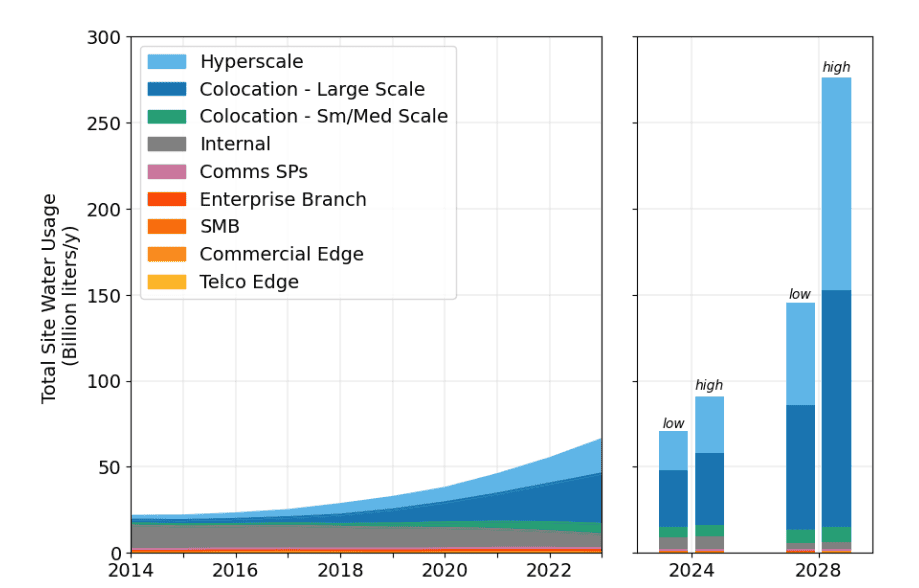
When looking at direct water use alone, data centers already rank among the ten most water-intensive industrial and commercial sectors in the United States, and this footprint is expected to grow rapidly. The 2024 United States Data Center Energy Usage Report projects that annual onsite water use could increase by two to four times between 2023 and 2028, rising to roughly 150–280 billion liters.
Direct Water Consumption by Data Center
Indirect Water Use: Power and Hardware Supply Chains
Data centers indirectly consume water through the power plant that supplies their electricity, where water-intensive steam cycles operate turbines. In addition, water is also consumed upstream during the manufacturing of the hardware deployed in data centers.
For example, producing one gallon of ultrapure water for microchip manufacturing requires approximately 1.5 gallons of tap water. The World Economic Forum reported that a single semiconductor fabrication facility can use around 10 million gallons of ultrapure water per day — an amount comparable to the daily water consumption of roughly 33,000 U.S. households.
Breaking Down Data Center Water Consumption
The table below clearly illustrates the difference between direct and indirect water usage in data centers. Findings from a June 2025 study by researchers at the University of Texas at Arlington and the University of California, Riverside quantify the water required to generate a single 150–300-word GPT-3 response:
| Water for Training (million L) | Water for Each Request (mL) | ||||
|---|---|---|---|---|---|
| Onsite Water | Offsite Water | Total Water | Onsite Water | Offsite Water | Total Water |
| 0.708 | 4.731 | 5.439 | 2.200 | 14.704 | 16.904 |
How Does AI Affect Water Usage in Data Centers?
Data centers already consume large volumes of water directly and indirectly, but the rapid growth of AI workloads is amplifying that impact. AI-driven computing introduces far higher heat densities than traditional workloads, pushing cooling systems beyond the limits of air-based approaches and accelerating the adoption of liquid cooling technologies that place greater strain on water resources.
Real-world examples underscore the scale of this impact:
- Microsoft reported a 34% increase in global water consumption during the development of its early AI tools.
- A data center cluster in Iowa consumed 6% of the local water district’s monthly supply while training GPT-4.
- Researchers at the University of California, Riverside estimate that by 2027, global AI demand could drive annual water withdrawals of 1.1 to 1.7 trillion gallons, more than four to six times Denmark’s total yearly water withdrawals.
How Much Water Do Data Centers Consume?
Water consumption varies widely depending on data center size, design, location, cooling approach, and workload, but even widely cited estimates show that water demand can be substantial.
Data Center Water Consumption by Scale, Type, and Function
- Medium-sized data centers (10–20 MW) can consume up to 110 million gallons of water per year for cooling alone.
- Average hyperscale data centers (~100 MW) in the U.S. may consume around 528,000 gallons per day
- ChatGPT-3 is estimated to use around 0.13 gallons of water per 10-50 responses.
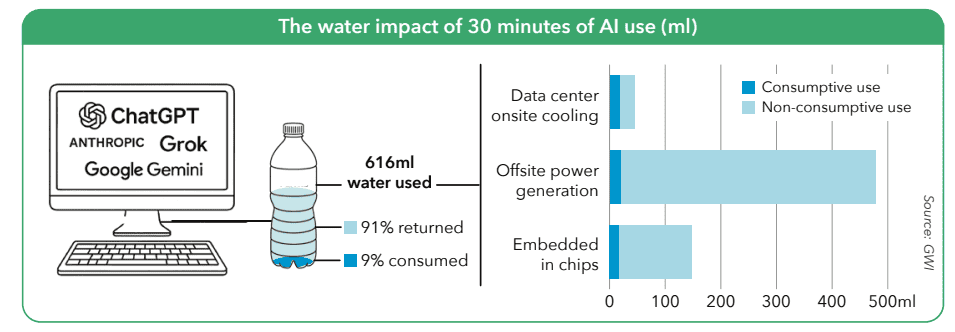
- According to a January 2026 analysis by Global Water Intelligence (GWI), 30 minutes of AI usage requires slightly more than 0.16 gallons of water (roughly the volume of a standard water bottle).
Strategies for Eliminating Replacement Water in the Cooling of Data Centers
Increasing scrutiny of data center water consumption has pushed many operators to rethink water stewardship and fundamentally reconsider how cooling systems are designed and deployed. Rather than simply reducing water use, the focus is shifting toward eliminating the need for replacement water altogether. One of the most visible signals of this shift came from Microsoft, which announced in 2024 its goal to operate a zero-water evaporation data center.
Cooling Technologies that Eliminate Replacement Water
Several cooling approaches are emerging that remove the need for replacement water:
Closed-Loop Cooling Systems
Closed-loop cooling recirculates the water used for cooling rather than evaporating it, avoiding the need for continuous water replenishment.
Mechanical (Air-Based) Cooling
Another alternative is relying on traditional mechanical cooling, similar to the chilled-air systems used in office and commercial environments. This approach eliminates evaporative water loss, but it typically comes with higher electricity demand, shifting sustainability tradeoffs from water to energy.
Immersion Cooling
Immersion cooling removes heat by submerging IT equipment in a non-conductive fluid, eliminating evaporative water use entirely. However, this approach often introduces challenges related to deployment compatibility and maintenance practices.
Hybrid Mechanical and Direct-to-Chip Cooling
Hybrid approaches combine mechanical cooling with direct-to-chip architectures, using mechanically chilled fluids rather than circulating water. This allows heat to be removed efficiently at the chip level while avoiding the continuous use and evaporation of water typical of traditional liquid cooling designs.
Cooling for a Water-Constrained Future
Water is no longer just a sustainability metric. It’s becoming a defining constraint shaping long-term scalability and site viability. For many data centers, the real challenge ahead isn’t necessarily how to use less water, but how to cool without depending on it at all.
Designed with this reality in mind, Airsys’ LiquidRack™ represents a distinct category of server-level cooling, delivering high-density performance while operating at 0 Water Usage Effectiveness (WUE). Rather than relying on facility-level evaporative cooling, LiquidRack removes replacement water from the equation where heat is generated (at the server itself), enabling scalable performance without adding water risk.
If you’re uncertain whether water availability could affect your next phase of growth, contact us today to discuss cooling strategies built for a water-constrained future.