
LiquidRack: The Low-Friction Liquid Cooling Retrofit for High Density AI Data Centers
May 18, 2026
Leading The Rapid Shift to Liquid Cooling
May 22, 2026
Inside Airsys’ Next Chapter: Signaling a New Era for High-Density AI Cooling
The data center industry is facing a massive inflection point. As AI workloads skyrocket, traditional infrastructure is being pushed to its absolute limits, forcing operators to completely rethink how they manage heat, power, and supply chain logistics.
In the latest episode of Data Centre Review’s “In the Spotlight” series, Jordan O’Brien (Managing Editor of Electrical Review and Data Centre Review) sat down with Airsys founder and CEO Yunshui Chen to discuss how the company is tackling these challenges head-on.
From scaling up localized manufacturing to pioneering the elimination of traditional chillers, here are the key takeaways from their conversation.
1. A Strategic Shift to North America
For Airsys, the future is firmly rooted in the North American market. Yunshui emphasized that this geographic prioritization is a decades-long commitment. By embedding operations directly within the US, Airsys is positioning itself to stay ahead of the massive wave of data center buildouts required to sustain the AI boom.
2. Building Supply Chain Resiliency Locally
Navigating global logistics has become increasingly complex, but Airsys is turning geopolitical and supply chain pressures into a competitive advantage. By moving production closer to its core customer base, the company is delivering two critical wins for data center operators:
- Zero Tariffs: Localized production helps partners completely bypass costly
import tariffs. - Accelerated Timelines: Eliminating reliance on transoceanic shipping
significantly tightens delivery schedules, keeping massive infrastructure projects
on track.
3. Advanced Manufacturing Capabilities
The expansion of Airsys’ domestic footprint represents far more than just additional capacity; it introduces a sophisticated level of technical capability to the region. The company’s facilities are equipped to handle advanced industrial operations, including large-scale 3D printing. This localized additive manufacturing capability allows Airsys to build an incredibly resilient supply chain, ensuring component availability and rapid prototyping right from the factory floor.
4. Pushing Boundaries: Eliminating the Chiller
Perhaps the most disruptive segment of the interview centered on the physical layer of AI infrastructure. Traditional HVAC and mechanical chiller setups struggle to efficiently cool high-density, server-level AI workloads.
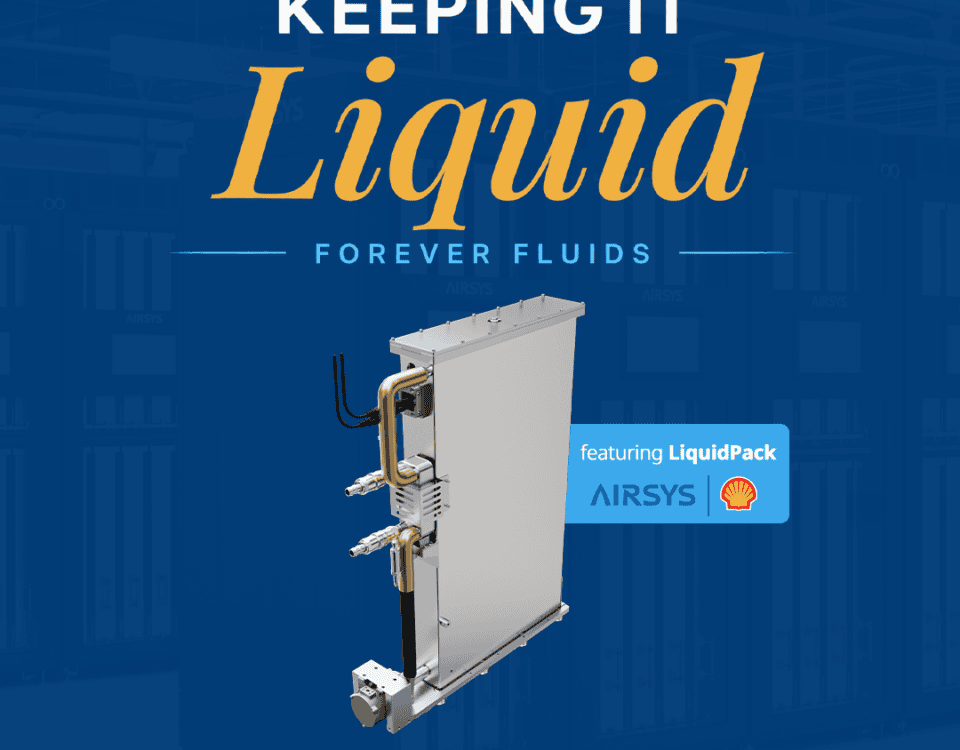
Airsys is tackling this by pushing the boundaries of liquid cooling technology — specifically focusing on its LiquidRack and advanced direct-to-chip two-phase solutions.
“In the end, we will fully eliminate the chillers, mechanical cooling in the infrastructure. So that will achieve the best allocation and effectiveness for cooling.” — Yunshui Chen, founder and CEO, Airsys
5. Winning the Public Conversation on Sustainability
As data centers face growing public and regulatory opposition over their environmental footprint, the shift away from energy-intensive mechanical chillers serves a dual purpose. It drastically reduces both Capex and Opex for operators while practicing genuine energy stewardship. By significantly cutting power draw at the cooling layer, Airsys aims to help the industry demonstrate that it can responsibly enable the future of AI while protecting the environment.