
Open Compute Project Accepts Power Compute Effectiveness White Paper Authored by Airsys Leaders
October 8, 2026Neoclouds have become key engines of AI growth, and they are turning to liquid cooling, heat reuse and other infrastructure innovations to keep pace.
Traditional hyperscalers and frontier AI labs could not build GPU capacity quickly enough to keep up with AI demand. Into that gap stepped an entirely new industry subcategory: the neoclouds.
What is a neocloud?
The term describes a class of providers of almost exclusively GPU-based infrastructure. Providers such as CoreWeave, Nebius, and Nscale have rushed in to fill that need for GPU capacity. However, not all providers embrace the label. Some feel “neocloud” implies a short-lived phenomenon or a business open to disintermediation, and many prefer to call themselves “AI cloud infrastructure” providers.
How big is the neocloud market?
By 2030, neocloud providers will capture 20% of the $267 billion AI cloud market, according to industry analyst Gartner. “While U.S. hyperscalers are launching their own sovereign offerings, a new wave of specialized neocloud providers is gaining significant traction,” said Enrique Castera, Senior Director Analyst at Gartner. “These neoclouds are differentiated by their focus on AI-optimized infrastructure and high-performance workloads.”
According to Synergy Research Group, neocloud providers are capturing an increasing share of the fastest-growing segments of the cloud market and reshaping the competitive dynamics of AI infrastructure, with the neocloud market forecast to approach $400 billion by 2031. “Focused on services such as GPU-as-a-Service (GPUaaS), generative AI platforms and high-density data center capacity, these providers are led by companies including CoreWeave, Crusoe, Core Scientific, Lambda, Nebius and Nscale,” the analyst stated.
Why are neoclouds moving to liquid cooling?
Being at the bleeding edge of AI infrastructure build-out and fulfilling a critical need for both speed and scale has put neoclouds at the forefront of AI data center innovation. CoreWeave offers a good example of this. At the end of 2024, it decided to invest heavily in liquid cooling to stay ahead of the increasing power density and heat requirements of the latest generations of AI equipment.
“CoreWeave’s decision and action have directly supported customers in their bold aspirations, including 9 of the 10 leading foundation model providers, as well as e-commerce, science, media and entertainment, and enterprise productivity organizations,” the company recently explained.
Innovations deployed by CoreWeave include:
- Liquid cooling: CoreWeave points to direct-to-chip cooling, in which liquid-filled plates sit directly on the chips, to remove heat far more effectively than air alone. This approach supports higher power densities without the performance throttling that occurs when air-cooled systems reach their limits. Just as importantly, stable operating temperatures help to limit the thermal stress and hardware degradation that can shorten the life of expensive GPUs.
- Scale: CoreWeave also credits its early commitment to liquid cooling with enabling it to bring successive generations of NVIDIA hardware, from Hopper to Blackwell and now Vera Rubin, into production at scale. Cooling infrastructure designed for tomorrow’s rack densities, rather than retrofitted to meet them, allows operators to deploy new platforms without redesigning their facilities each time.
- Sustainability: There is also a sustainability dimension, which is increasingly important as neoclouds expand into new communities. Closed-loop liquid cooling systems recirculate coolant through chillers and dry coolers, reducing water usage. According to CoreWeave, coolant loss in such systems is minimal, requiring attention only once every few years.
- Intelligence: Finally, cooling is also getting smarter. CoreWeave has described using AI agents to monitor its infrastructure in real time and manage thermal increases before they affect GPU performance. The trend is toward cooling that is liquid-based, closely monitored and dynamically controlled.
How are neoclouds reusing data center heat?
CoreWeave is not alone in pushing infrastructure boundaries. Nebius, a Europe-based neocloud, is building one of the largest footprints of purpose-built AI infrastructure and has raised its target to 5GW of contracted power by the end of 2026.
Nebius is building out several facilities in Finland. Like CoreWeave, its planned 310 MW Lappeenranta site will use liquid cooling, but it will also reuse heat. “Servers will be cooled using a closed-loop liquid cooling system, eliminating the need for the AI factory to rely on water intake from local supplies and thus keeping water consumption to a minimum,” the company stated in a recent announcement. “The cooling system will be designed to integrate a heat recovery system, opening the opportunity for excess server heat to be donated to the local district heating network.”
According to Nebius, another facility in Mäntsälä, Finland, has supplied more than 30 GWh of heat in the past two years, covering up to 72% of the town’s annual heating demand. “In 2024 alone, this reduced local heating-related emissions by 54%, by an estimated 3,220 tonnes of CO₂ equivalent. With the ongoing expansion, the system has the potential to deliver even greater volumes of recovered heat in the years ahead,” the company stated.
The heat recovery process is fully integrated into the data center’s architecture, according to Nebius. “Hot air from the server rooms is passed through air-to-water heat exchangers, where it is used to raise water temperatures to 35–40°C [95–104°F]. The municipality then boosts the temperature further to the standard 55–60°C [131–140°F] before transferring it to the local network for distribution.”
At Mäntsälä, the heat source is hot air from the server rooms, and Nebius describes the site as air-cooled. Its newer Finnish projects are being designed around liquid. Heat reuse, in other words, is not tied to a single cooling technology, but it does shape how the cooling system must be designed from the outset.
What do neoclouds need from cooling?
Across these deployments, a common set of requirements emerges. Neoclouds need:
- Cooling that keeps pace with each new GPU generation rather than lagging it.
- Designs that can be deployed quickly and repeatedly across sites.
- Thermal performance reliable enough to protect GPU availability and customer commitments.
- Water and energy profiles that earn the support of the communities and utilities on which new campuses depend.
- Flexibility: air and liquid side by side, new build and retrofit, and sites in very different climates and regulatory environments.
Why is cooling a competitive differentiator for neoclouds?
For neoclouds, cooling has moved from facilities infrastructure to a potential competitive differentiator. In a market measured in gigawatts and GPU generations, the winners will be those that add capacity fastest without compromising uptime, energy and water performance, or community support.
Power allocation is part of the same equation. Alongside power efficiency, operators need to know how much of a site’s provisioned power is allocated to compute. Power Compute Effectiveness (PCE), introduced in a white paper authored by Airsys leaders and published by the Open Compute Project (OCP), captures that allocation: provisioned power for compute divided by provisioned total data center power. Where Power Usage Effectiveness (PUE) measures efficiency, PCE measures effectiveness, showing how much of a facility’s provisioned power is structurally available for compute rather than for cooling and other supporting infrastructure.
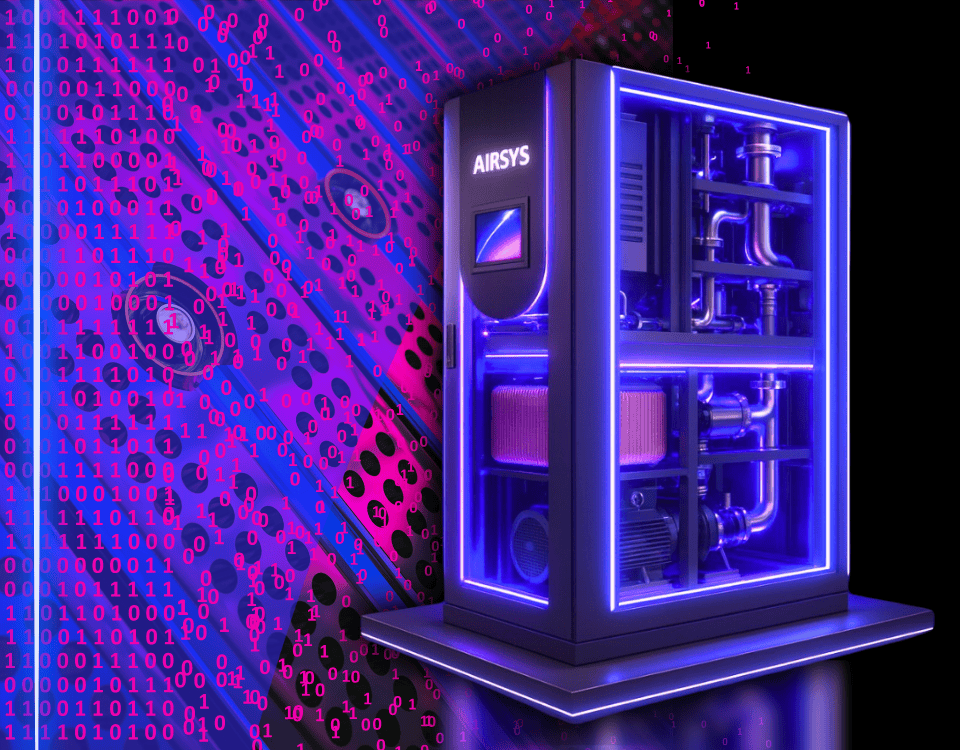
For a neocloud, cooling infrastructure ultimately has to support the product it sells: available GPU capacity. That means designing thermal systems around time-to-capacity and uptime. That is the perspective Airsys brings to the market, with coolant distribution units such as FluidCool-X™ and a portfolio of air and liquid cooling systems designed for high-density AI workloads and 24/7 operations.
Neoclouds may no longer be the new kids on the block, but they remain at the vanguard of AI infrastructure. As each GPU generation pushes rack densities higher, the ones that keep their cool will be those whose cooling was built for what comes next.
Frequently asked questions
What is a neocloud?
A neocloud is a cloud provider focused almost exclusively on GPU-based infrastructure for AI workloads, often sold as GPU-as-a-Service. Examples include CoreWeave, Crusoe, Lambda, Nebius and Nscale.
Why are neoclouds adopting liquid cooling?
Each new generation of AI hardware raises rack power densities beyond what air cooling alone can readily support. Direct-to-chip liquid cooling removes heat at the chip, which helps prevent thermal throttling. CoreWeave credits its early move to liquid cooling with letting it bring successive NVIDIA GPU generations into production at scale.
What does a coolant distribution unit (CDU) do?
In a direct-to-chip system, a CDU circulates coolant through the cold plates on the chips and transfers that heat to the facility’s heat-rejection loop, keeping the two loops separate while controlling flow and temperature. Airsys’ FluidCool-X™ is one example.
What is Power Compute Effectiveness (PCE)?
PCE is provisioned power for compute divided by provisioned total data center power, expressed as a value between 0 and 1. It shows how a facility’s provisioned power is allocated between compute and supporting infrastructure. PCE is an effectiveness ratio, not an efficiency metric; Power Usage Effectiveness (PUE) measures efficiency.
Can data center heat be reused?
Yes. Nebius reports that its air-cooled site in Mäntsälä, Finland, has supplied more than 30 GWh of heat over two years, covering up to 72% of the town’s annual heating demand. Its planned Lappeenranta site is being designed to integrate heat recovery with closed-loop liquid cooling.